













AI FOR FINANCE

AI-Powered CFO Services

AI is already changing how financial data moves through the business.
We help you use that speed properly – with clearer visibility and better decisions.

AI CFO Solutions Driving Strategic Growth

Most businesses already have access to financial data. What slows things down is how long it takes to turn that data into something usable.

AI-powered CFO services reduce that delay.

Financial models can update more frequently. Reporting cycles shorten. Patterns in cash flow and margins become visible earlier – before they turn into problems.

That said, the value isn’t coming from automation alone.  AI CFO services are only effective when paired with financial judgment. Data can surface trends, but it doesn’t decide whether to slow hiring, adjust pricing, or change direction. That still requires context.

This is typically where broader fractional CFO support becomes necessary – connecting faster data to real business decisions and execution.

ai-powered cfo

Core AI-Optimized Financial Services We Provide

Financial capabilities focused on faster visibility and better decisions.

Budgeting & Forecasting

Build forward-looking financial plans that support growth and better decisions.

Operational Finance

Maintain reliable reporting, improve margins and cost structure, and support audits.

Cash Flow & Capital Planning

Manage cash flow, plan capital needs, and support financing and banking relationships.

Financial Planning & Analysis

Build models and KPIs, analyze performance trends, and deliver actionable insights.

Board & Investor Relations

Support board reporting, investor communications, and fundraising readiness.

Transaction Readiness

Prepare for fundraising, M&A, or exits with clean books and clear metrics.

Why Rushing Into AI Can Backfire

Pushing AI before financial clarity is in place leads to expensive mistakes.

Pressure to Move Faster Than the Business Is Ready

There’s real pressure right now to move on AI.

For many companies, it’s not coming from a defined operational need – it’s coming from a sense that waiting too long means falling behind.

That pressure leads to decisions happening out of sequence.

Weak Financial Structure Gets Amplified

AI doesn’t fix weak financial infrastructure. It depends on it.

If reporting is inconsistent, if systems don’t reconcile cleanly, or if forecasts aren’t trusted, adding automation tends to scale those issues rather than resolve them. The output may look more advanced, but the underlying logic hasn’t improved.

That’s where mistakes start to get expensive.

You end up with:

  • decisions built on partial or misaligned data
  • confidence in outputs that haven’t been pressure-tested
  • faster execution on assumptions that shouldn’t have been made

Most of this doesn’t show up immediately. It appears later – after capital has been committed or direction has already been set.

The Issue Is Sequence, Not Technology

The issue isn’t the tools. It’s the order.

Before layering in AI, the business needs financial structure that holds under pressure – particularly around cash flow visibility and forecasting discipline.

A company updating forecasts once a month may not catch a cash constraint until it’s already a problem. With faster iteration, that same issue can surface weeks earlier – while there’s still time to adjust.

cfo ai solutions

Where CFO Involvement Actually Matters

That’s where CFO involvement matters.

Not to implement tools – but to evaluate whether the business is ready to use them without introducing risk.

A CFO can assess:

  • how reliable your financial data is across systems
  • whether reporting supports automation
  • where AI improves decisions – and where it creates distortion

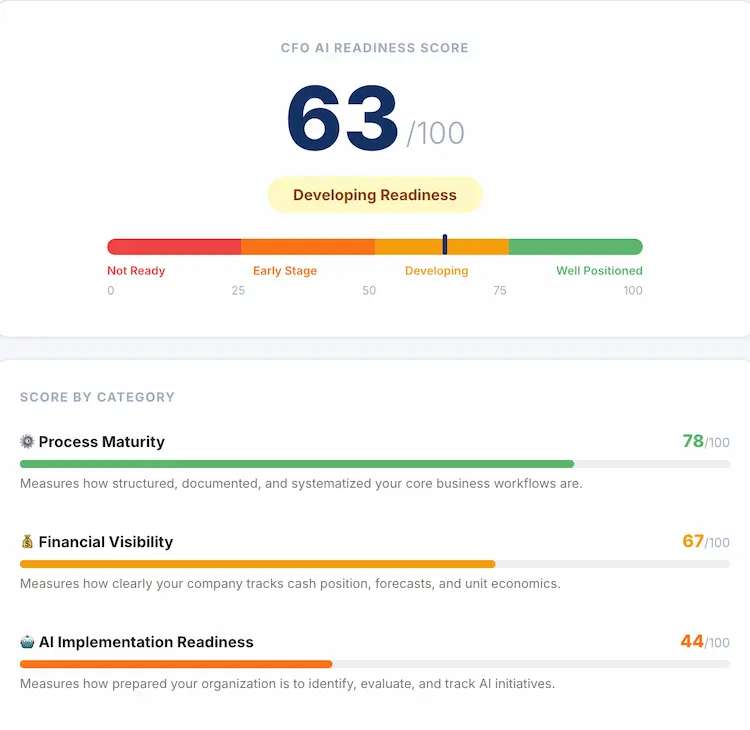
If you want a starting point, use the 2-minute AI readiness evaluation tool  It gives a clear view of where things stand and what should happen next.

From there, the path becomes clearer – move forward, or fix what’s underneath first.

How it works

How Our AI-Powered CFO Engagement Works

1

Tell us what you need

Answer four short questions about your goals, industry and company size. It takes about two minutes – no cost, no obligation.

2

Get introduced

Our team reviews every suggested match and introduces you by email to CFOs who know your industry, usually within hours.

3

Talk, compare, choose

Speak with as many or as few from your shortlist as you like. Agree scope and rate directly. Hire only if it feels right.

Our network

AI-Powered CFO Experts Supporting Smarter Business Finance

All CFOs are experienced operators with backgrounds in Fortune 500, PE-backed, and high-growth companies. A small sample below – browse the full directory to see everyone.

Jamie Mendillo
CFO
Drove $30M in sales growth over two years at a $200M manufacturer, cut AR $4M (20%) in three months, and cleared 40 audit findings without adding staff.

Benefits of AI CFO Consultants for Your Business

AI CFO

Working with AI CFO consultants changes the timing of financial decisions.

Most financial processes lag behind the business. Reports reflect what already happened. Forecasts are updated infrequently. By the time decisions are made, conditions have shifted.

CFO AI solutions help close that gap.

Forecasts can be updated continuously instead of rebuilt from scratch. Variances show up earlier. Scenario planning becomes practical because assumptions can be adjusted quickly without resetting the entire model.

For an AI CFO startup environment, this changes how decisions get made. Early-stage companies move quickly – hiring, investing, adjusting direction – often without full visibility. Faster financial feedback reduces the risk of committing too early or scaling in the wrong direction.

There’s also a consistency benefit.

Reducing manual processes limits the points where errors and delays tend to enter. Reporting becomes more reliable. Decision-making becomes less reactive.

None of this replaces the CFO.

AI improves how information is processed. The CFO determines what matters and what actions to take.

Used properly, this leads to:

  • earlier visibility into constraints
  • clearer trade-offs in decision-making
  • more controlled growth

The result is better timing – decisions happen sooner, with clearer context.


FAQ

Companies dealing with increasing complexity or faster decision cycles tend to benefit the most. This usually includes businesses where timing matters – not just accuracy – and where financial visibility directly impacts operational decisions.

It improves how quickly financial data becomes usable. Instead of waiting on static reports, leadership can see changes in performance earlier and adjust direction before issues compound.

They can be, especially when decisions are happening quickly and resources are limited. The key is making sure the underlying financial structure is solid before relying on automated outputs.

Security depends on how systems are implemented and controlled. Most platforms follow strong data protection standards, but oversight and access management still need to be handled carefully.

Any business where financial visibility affects decision-making can benefit. This includes SaaS, eCommerce, manufacturing, and service-based companies where timing and accuracy both matter.